
How to Choose a Hydraulic Motor: Practical Tips and Recommendations
A hydraulic motor is a device that converts the energy of a fluid into mechanical motion. The rotational torque from the main shaft of the hydraulic motor is transmitted to other critical mechanical systems that perform the actual work. Compared to electric motors, hydraulic motors are generally more compact. In addition, they require less demanding maintenance. Moreover, their rotational speed can be easily controlled by regulating the fluid flow.
How a Hydraulic Motor Works
A hydraulic motor is designed to efficiently convert the energy of a flowing fluid into mechanical work. The rotating system of the motor and its transmission components operate due to the driving force generated by the flow of pressurized fluid.
A hydraulic motor is a relatively complex mechanism widely used across various industries, as well as for solving specific engineering tasks. Such systems are adapted for operation in both open and closed circuits. They can be integrated into different technical systems and perform a wide range of functions. A key component of any hydraulic system is the pump, which is responsible for generating the fluid flow and ensuring the required pressure. The maximum rotational speed of the main shaft depends directly on it.
Types of Hydraulic Motors
Each hydraulic motor model differs in design, operating principle, and functional capabilities. Today, hydraulic motors are widely used in heavy machinery due to:
- low maintenance costs,
- relatively low weight,
- energy efficiency,
- resistance to temperature fluctuations.
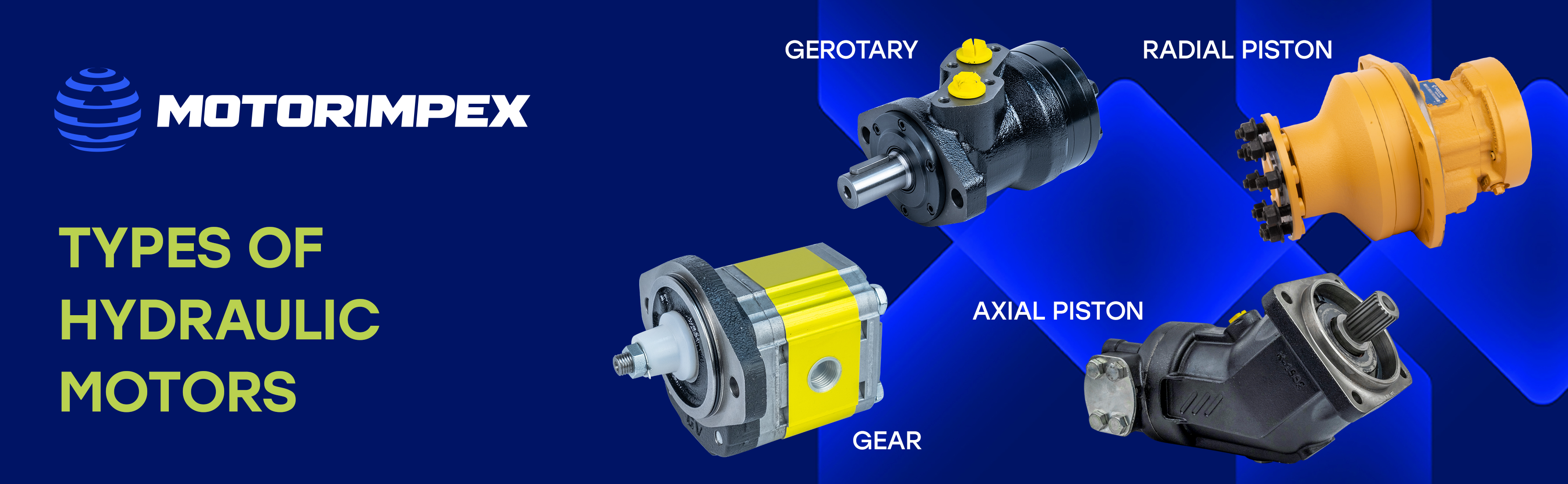
Currently, the following hydraulic motors are known:
|
Type |
Description |
|
Axial Piston Motors |
These include specialized chambers and pistons. The pistons are positioned in inclined discs, which regulate rotational intensity and other performance parameters. |
|
Radial Piston Motors |
Another piston-based type, but unlike axial designs, the pistons are arranged in separate cylinders. Fluid supply is isolated, allowing precise power control. The pistons form a unified mechanism with the motor shaft, transmitting rotation. |
|
Gerotary Motors |
Capable of continuous rotation, making them highly versatile across different applications. Their core element is a gerotor pair – a gear mechanism integrated with the motor shaft. There are numerous variations of these motors, including low-speed configurations. |
|
Gear Motors |
Can combine the functions of both a pump and a motor. Their working section consists of specialized gears. During operation, it is essential to monitor the fluid quantity and temperature. |
Challenges in Selecting a Hydraulic Motor
Choosing a hydraulic motor for a specific application is a complex task that requires in-depth technical expertise. To properly determine how to select a hydraulic motor, the following factors must be considered:
- design type;
- intended application and operating tasks;
- required torque;
- nominal operating pressure;
- rated rotational speed specified by the manufacturer;
- cost, etc.
When selecting a motor, it is essential to clearly understand the functions it must perform. Each hydraulic motor has its own unique technical characteristics and performance properties.
Where to Buy a Hydraulic Motor
You can purchase a hydraulic motor for seamless integration into your equipment by contacting our company. Our catalog features hydraulic motors certified by manufacturers. You can place an order directly on the Motorimpex website. If you have any questions, you can always contact our specialist by phone. They will help you select the most suitable and efficient unit tailored to your specific requirements. We offer impeccable quality, reliability, and competitive pricing.


